
Ras Recombinant Rabbit Monoclonal Antibody [SA39-05]




Catalog# ET1601-16
Ras Recombinant Rabbit Monoclonal Antibody [SA39-05]
-
WB
-
IF-Cell
-
FC
-
IP
-
Human
-
Mouse
-
Rat
-
Zebrafish
 预测的种属支持售后
概述
产品名称
Ras Recombinant Rabbit Monoclonal Antibody [SA39-05]
抗体类型
Recombinant Rabbit monoclonal Antibody
免疫原
Synthetic peptide within Human Ras aa 7-56 / 189.
种属反应性
Human, Mouse, Rat (Predicted: Zebrafish)
预测的种属支持售后
验证应用
WB, IF-Cell, FC, IP
分子量
Predicted band size: 21 kDa
阳性对照
293T cell lysate, MCF7 cell lysate, NIH/3T3 cell lysate, Neuro-2a cell lysate, PC-12 cell lysate, Mouse brain tissue lysate, MCF7, NIH/3T3, PC-12.
偶联
unconjugated
克隆号
SA39-05
RRID
产品特性
形态
Liquid
存放说明
Shipped at 4℃. Store at +4℃ short term (1-2 weeks). It is recommended to aliquot into single-use upon delivery. Store at -20℃ long term.
存储缓冲液
1*TBS (pH7.4), 0.05% BSA, 40% Glycerol. Preservative: 0.05% Sodium Azide.
亚型
IgG
纯化方式
Protein A affinity purified.
应用稀释度
-
WB
-
1:1,000-1:2,000
-
IF-Cell
-
1:100
-
FC
-
1:1,000
-
IP
-
1-2μg/sample
发表文章中的应用
| WB | 查看 2 篇文献如下 |
发表文章中的种属
| Human | 查看 2 篇文献如下 |
靶点
功能
Ras, from "Rat sarcoma virus", is a family of related proteins that are expressed in all animal cell lineages and organs. All Ras protein family members belong to a class of protein called small GTPase, and are involved in transmitting signals within cells (cellular signal transduction). Ras is the prototypical member of the Ras superfamily of proteins, which are all related in three-dimensional structure and regulate diverse cell behaviours. When Ras is 'switched on' by incoming signals, it subsequently switches on other proteins, which ultimately turn on genes involved in cell growth, differentiation, and survival. Mutations in Ras genes can lead to the production of permanently activated Ras proteins, which can cause unintended and overactive signaling inside the cell, even in the absence of incoming signals. Because these signals result in cell growth and division, overactive Ras signaling can ultimately lead to cancer. The three Ras genes in humans (HRAS, KRAS, and NRAS) are the most common oncogenes in human cancer.
背景文献
1. "NRAS mutation causes a human autoimmune lymphoproliferative syndrome." Oliveira J.B. Bidere N. Niemela J.E. Zheng L. Sakai K., Nix C.P. Danner R.L. Barb J., Munson P.J. Puck J.M. Dale J. Straus S.E. Fleisher T.A. Lenardo M.J. Proc. Natl. Acad. Sci. U.S.A. 104:8953-8958(2007)
序列相似性
Belongs to the small GTPase superfamily. Ras family.
翻译后修饰
Palmitoylated by the ZDHHC9-GOLGA7 complex. Depalmitoylated by ABHD17A, ABHD17B and ABHD17C. A continuous cycle of de- and re-palmitoylation regulates rapid exchange between plasma membrane and Golgi.; Acetylation at Lys-104 prevents interaction with guanine nucleotide exchange factors (GEFs).; Ubiquitinated by the BCR(LZTR1) E3 ubiquitin ligase complex at Lys-170 in a non-degradative manner, leading to inhibit Ras signaling by decreasing Ras association with membranes.; Phosphorylation at Ser-89 by STK19 enhances NRAS-association with its downstream effectors.
亚细胞定位
Cytoplasm, Cell membrane, Golgi apparatus.
UNIPROT
别名
C-BAS/HAS antibody
c-H-ras antibody
C-HA-RAS1 antibody
CTLO antibody
GTPase HRas antibody
GTPase KRas antibody
GTPase NRas antibody
H-Ras-1 antibody
H-RASIDX antibody
Ha-Ras antibody
展开图片
-
Western blot analysis of Ras on different lysates with Rabbit anti-Ras antibody (ET1601-16) at 1/1,000 dilution.
Lane 1: 293T cell lysate (10 µg/Lane)
Lane 2: MCF7 cell lysate (10 µg/Lane)
Lane 3: NIH/3T3 cell lysate (10 µg/Lane)
Lane 4: Neuro-2a cell lysate (10 µg/Lane)
Lane 5: PC-12 cell lysate (10 µg/Lane)
Lane 6: Mouse brain tissue lysate (20 µg/Lane)
Predicted band size: 21 kDa
Observed band size: 21 kDa
Exposure time: 30 seconds; ECL: K1801;
4-20% SDS-PAGE gel.
Proteins were transferred to a PVDF membrane and blocked with 5% NFDM/TBST for 1 hour at room temperature. The primary antibody (ET1601-16) at 1/1,000 dilution was used in 5% NFDM/TBST at 4℃ overnight. Goat Anti-Rabbit IgG - HRP Secondary Antibody (HA1001) at 1/50,000 dilution was used for 1 hour at room temperature. -
Immunocytochemistry analysis of MCF7 cells labeling Ras with Rabbit anti-Ras antibody (ET1601-16) at 1/100 dilution.
Cells were fixed in 4% paraformaldehyde for 15 minutes at room temperature, permeabilized with 0.1% Triton X-100 in PBS for 15 minutes at room temperature, then blocked with 1% BSA in 10% negative goat serum for 1 hour at room temperature. Cells were then incubated with Rabbit anti-Ras antibody (ET1601-16) at 1/100 dilution in 1% BSA in PBST overnight at 4 ℃. Goat Anti-Rabbit IgG H&L (iFluor™ 488, HA1121) was used as the secondary antibody at 1/1,000 dilution. PBS instead of the primary antibody was used as the secondary antibody only control. Nuclear DNA was labelled in blue with DAPI.
Beta tubulin (HA601187, red) was stained at 1/100 dilution overnight at +4℃. Goat Anti-Mouse IgG H&L (iFluor™ 594, HA1126) was used as the secondary antibody at 1/1,000 dilution. -
Immunocytochemistry analysis of NIH/3T3 cells labeling Ras with Rabbit anti-Ras antibody (ET1601-16) at 1/100 dilution.
Cells were fixed in 4% paraformaldehyde for 15 minutes at room temperature, permeabilized with 0.1% Triton X-100 in PBS for 15 minutes at room temperature, then blocked with 1% BSA in 10% negative goat serum for 1 hour at room temperature. Cells were then incubated with Rabbit anti-Ras antibody (ET1601-16) at 1/100 dilution in 1% BSA in PBST overnight at 4 ℃. Goat Anti-Rabbit IgG H&L (iFluor™ 488, HA1121) was used as the secondary antibody at 1/1,000 dilution. PBS instead of the primary antibody was used as the secondary antibody only control. Nuclear DNA was labelled in blue with DAPI.
Beta tubulin (HA601187, red) was stained at 1/100 dilution overnight at +4℃. Goat Anti-Mouse IgG H&L (iFluor™ 594, HA1126) was used as the secondary antibody at 1/1,000 dilution. -
Immunocytochemistry analysis of PC-12 cells labeling Ras with Rabbit anti-Ras antibody (ET1601-16) at 1/100 dilution.
Cells were fixed in 4% paraformaldehyde for 15 minutes at room temperature, permeabilized with 0.1% Triton X-100 in PBS for 15 minutes at room temperature, then blocked with 1% BSA in 10% negative goat serum for 1 hour at room temperature. Cells were then incubated with Rabbit anti-Ras antibody (ET1601-16) at 1/100 dilution in 1% BSA in PBST overnight at 4 ℃. Goat Anti-Rabbit IgG H&L (iFluor™ 488, HA1121) was used as the secondary antibody at 1/1,000 dilution. PBS instead of the primary antibody was used as the secondary antibody only control. Nuclear DNA was labelled in blue with DAPI.
Beta tubulin (HA601187, red) was stained at 1/100 dilution overnight at +4℃. Goat Anti-Mouse IgG H&L (iFluor™ 594, HA1126) was used as the secondary antibody at 1/1,000 dilution. -
Flow cytometric analysis of MCF7 cells labeling Ras.
Cells were fixed and permeabilized. Then stained with the primary antibody (ET1601-16, 1/1,000) (red) compared with Rabbit IgG Isotype Control (green). After incubation of the primary antibody at +4℃ for an hour, the cells were stained with a iFluor™ 488 conjugate-Goat anti-Rabbit IgG Secondary antibody (HA1121) at 1/1,000 dilution for 30 minutes at +4℃. Unlabelled sample was used as a control (cells without incubation with primary antibody; black). -
Flow cytometric analysis of NIH/3T3 cells labeling Ras.
Cells were fixed and permeabilized. Then stained with the primary antibody (ET1601-16, 1/1,000) (red) compared with Rabbit IgG Isotype Control (green). After incubation of the primary antibody at +4℃ for an hour, the cells were stained with a iFluor™ 488 conjugate-Goat anti-Rabbit IgG Secondary antibody (HA1121) at 1/1,000 dilution for 30 minutes at +4℃. Unlabelled sample was used as a control (cells without incubation with primary antibody; black). -
Flow cytometric analysis of PC-12 cells labeling Ras.
Cells were fixed and permeabilized. Then stained with the primary antibody (ET1601-16, 1/1,000) (red) compared with Rabbit IgG Isotype Control (green). After incubation of the primary antibody at +4℃ for an hour, the cells were stained with a iFluor™ 488 conjugate-Goat anti-Rabbit IgG Secondary antibody (HA1121) at 1/1,000 dilution for 30 minutes at +4℃. Unlabelled sample was used as a control (cells without incubation with primary antibody; black). -
Ras was immunoprecipitated from 0.2 mg MCF7 cell lysate with ET1601-16 at 2 µg/10 µl beads. Western blot was performed from the immunoprecipitate using ET1601-16 at 1/2,000 dilution. HRP Conjugated Anti-Rabbit IgG for IP Nano-secondary antibody at 1/5,000 dilution was used for 1 hour at room temperature.
Lane 1: MCF7 cell lysate (input)
Lane 2: ET1601-16 IP in MCF7 cell lysate
Lane 3: Rabbit IgG instead of ET1601-16 in MCF7 cell lysate
Blocking/Dilution buffer: 5% NFDM/TBST
Exposure time: 10 seconds; ECL: K1801
请注意: All products are "FOR RESEARCH USE ONLY AND ARE NOT INTENDED FOR DIAGNOSTIC OR THERAPEUTIC USE"
引文
-
Matrix vesicles from osteoblasts promote atherosclerotic calcification
Author: Xiaoli Wang,et al
PMID: 39580186
期刊: Matrix Biology
应用: WB
反应种属: Human
发表时间: 2024 Oct
-
 Citation
-
Zoledronic acid enhances the efficacy of the MEK inhibitor trametinib in KRAS mutant cancers.
Author:
PMID: 30429107
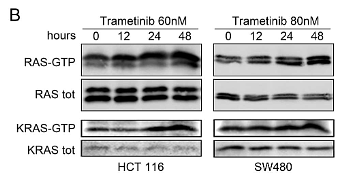
期刊: Cancer Letters
应用: WB
反应种属: Human
发表时间: 2019 Feb
-
Citation
同靶点 & 同通路的产品

Ras Rabbit Polyclonal Antibody
Application: WB,IF-Cell,IHC-P,FC
Reactivity: Human,Mouse,Rat
Conjugate: unconjugated

Ras Recombinant Rabbit Monoclonal Antibody [JE44-13]
Application: WB,IF-Cell,FC
Reactivity: Human,Mouse,Rat
Conjugate: unconjugated
